The "Pretzel" Myth
Jul 23, 2026
The "Pretzel" Myth
The Reflection
Take a second and picture a "yoga person."
If you are like 90% of the population, your brain immediately goes to an elite gymnast contorted into a human pretzel, doing a handstand on a beach, or effortlessly wrapping their leg behind their head.
Then, you look at your own body. You haven't touched your toes since middle school. Your lower back aches when you stand up from your desk, and your shoulders feel like solid concrete. You think to yourself:
"Well, I'm clearly not built for yoga. I'd just embarrass myself."
We hear this from men and women every single day: "I want to work on my mobility, but I'm waiting until I get a little more flexible before | try yoga."
Let's stop right there. Saying you are too stiff to do yoga is like saying you are too dirty to take a shower.
You don't get flexible to do yoga; you do yoga to get flexible. We will dive into the why being stiff isn't a disqualifier-it actually makes you the perfect candidate.
The Illusion of the "Yoga Body"
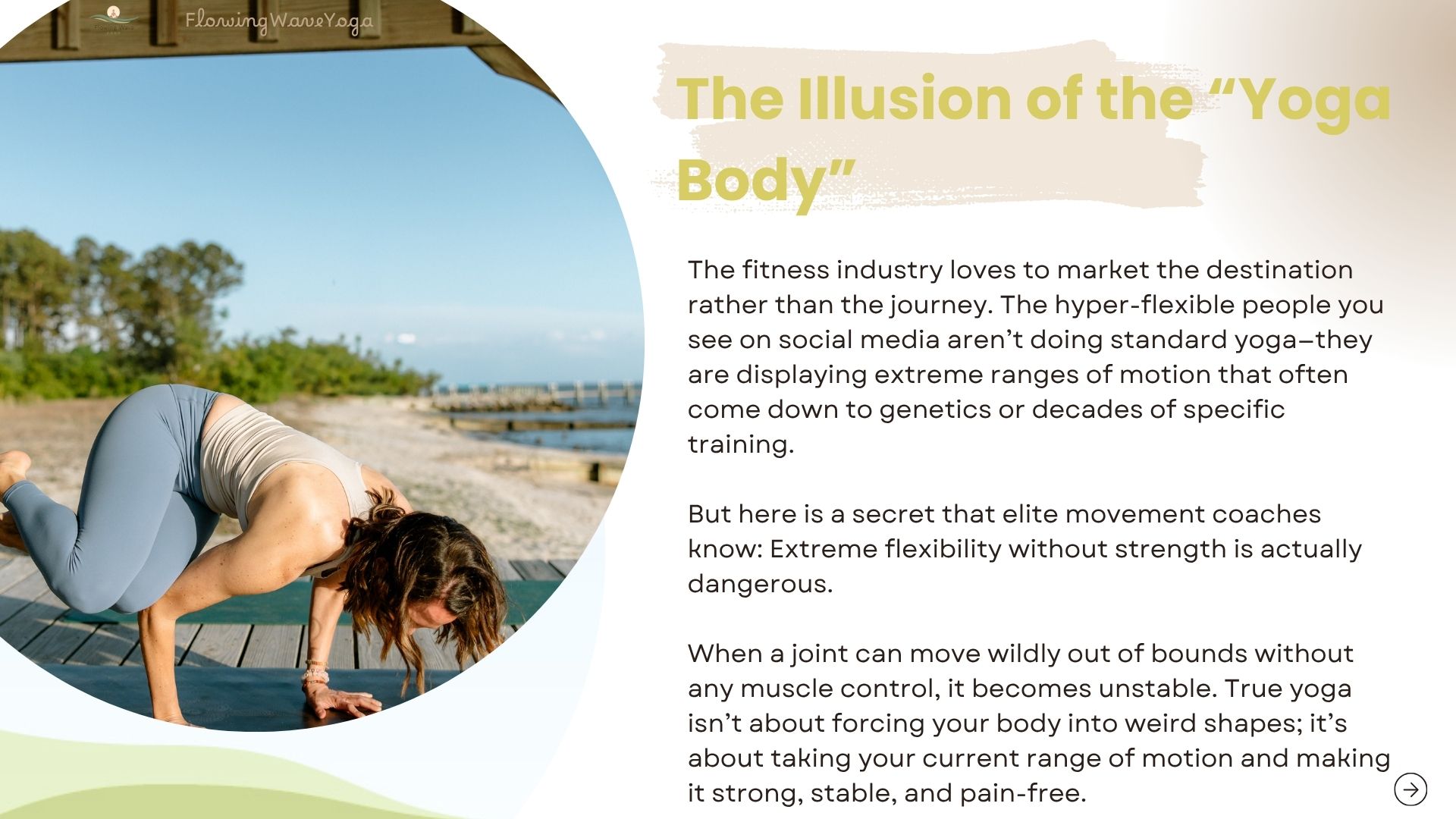
The fitness industry loves to market the destination rather than the journey. The hyper-flexible people you see on social media aren't doing standard yoga-they are displaying extreme ranges of motion that often come down to genetics or decades of specific training.
But here is a secret that elite movement coaches know: Extreme flexibility without strength is actually dangerous.
When a joint can move wildly out of bounds without any muscle control, it becomes unstable. True yoga isn't about forcing your body into weird shapes; it's about taking your current range of motion and making it strong, stable, and pain-free.
The science of stiffness: why your body locks up
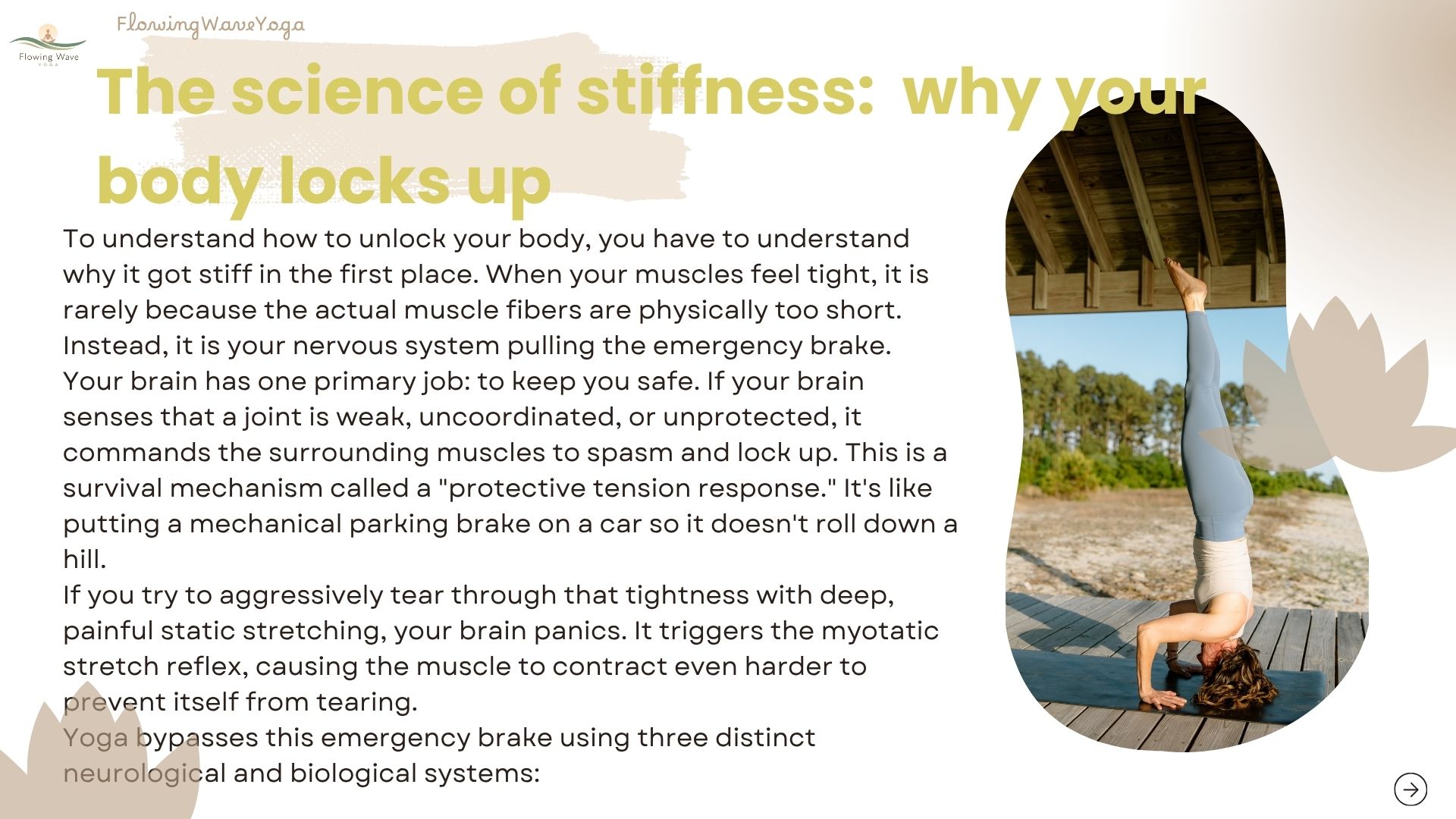
To understand how to unlock your body, you have to understand why it got stiff in the first place. When your muscles feel tight, it is rarely because the actual muscle fibers are physically too short.
Instead, it is your nervous system pulling the emergency brake.
Your brain has one primary job: to keep you safe. If your brain senses that a joint is weak, uncoordinated, or unprotected, it commands the surrounding muscles to spasm and lock up. This is a survival mechanism called a "protective tension response." It's like putting a mechanical parking brake on a car so it doesn't roll down a hill.
If you try to aggressively tear through that tightness with deep, painful static stretching, your brain panics. It triggers the myotatic stretch reflex, causing the muscle to contract even harder to prevent itself from tearing.
Yoga bypasses this emergency brake using three distinct neurological and biological systems.
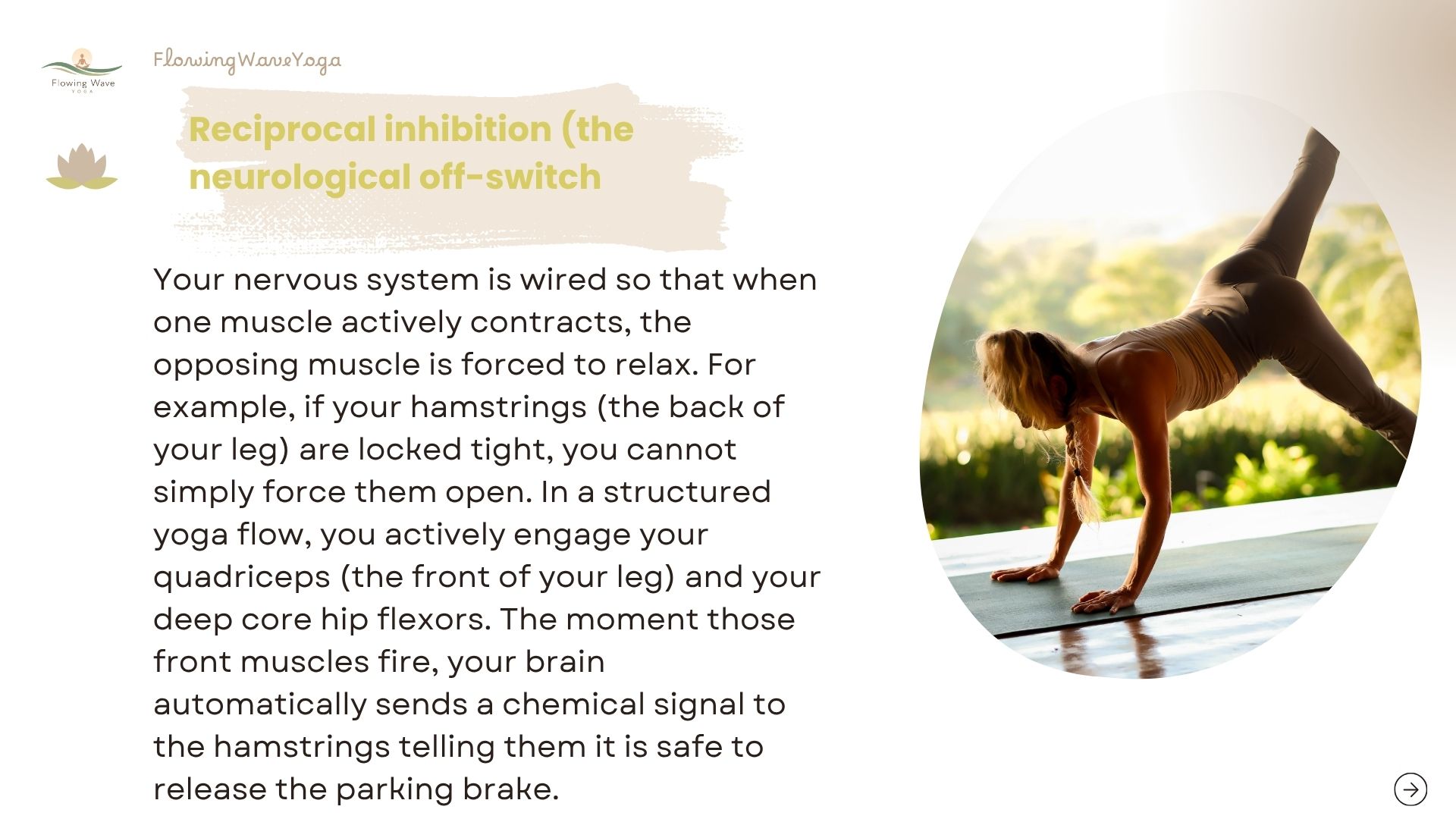
1. Reciprocal inhibition (the neurological off-switch)
Your nervous system is wired so that when one muscle actively contracts, the opposing muscle is forced to relax. For example, if your hamstrings (the back of your leg) are locked tight, you cannot simply force them open. In a structured yoga flow, you actively engage your quadriceps (the front of your leg) and your deep core hip flexors. The moment those front muscles fire, your brain automatically sends a chemical signal to the hamstrings telling them it is safe to release the parking brake.
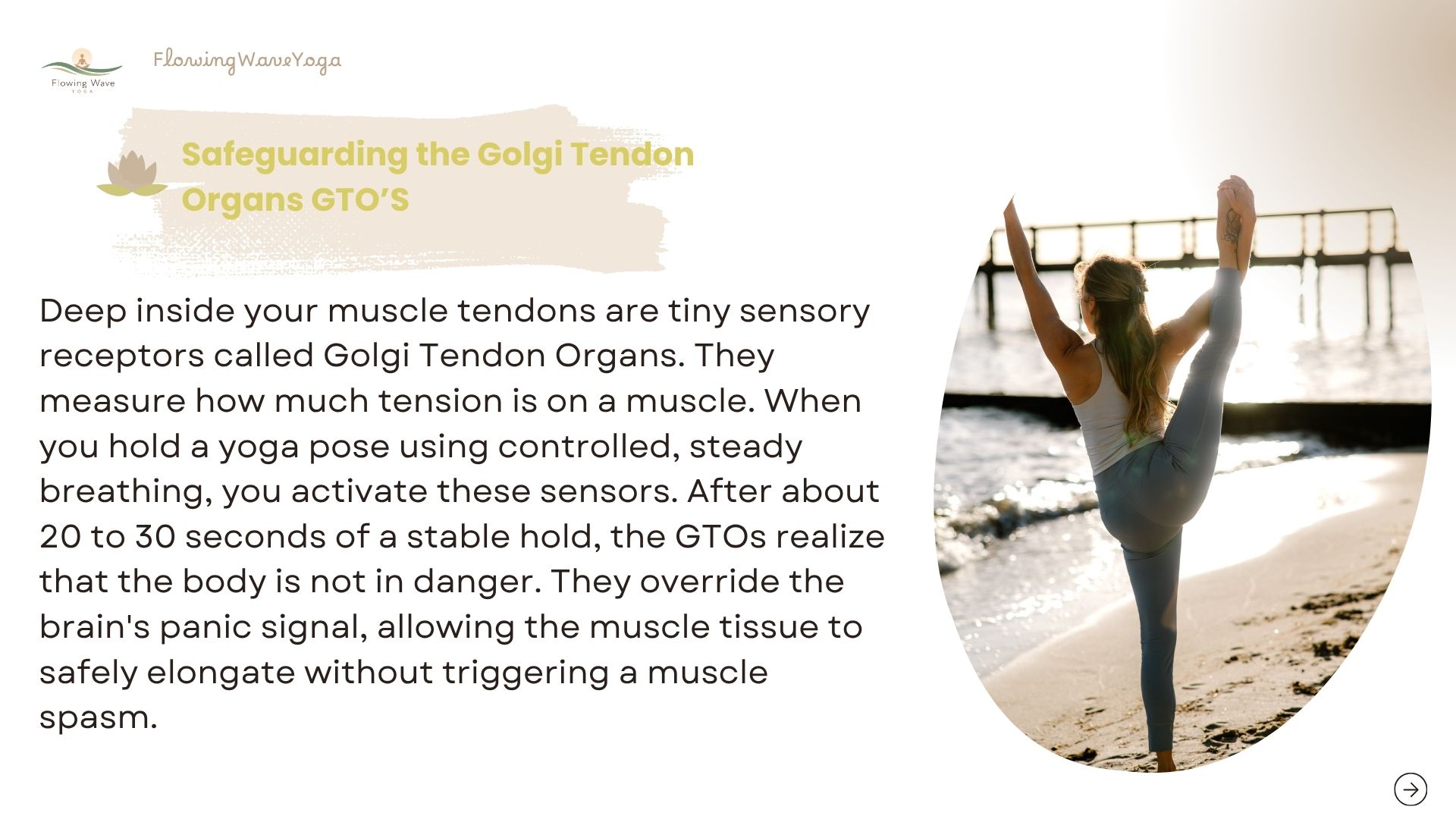
2. Safeguarding the Golgi Tendon
Organs GTO'S
Deep inside your muscle tendons are tiny sensory receptors called Golgi Tendon Organs. They measure how much tension is on a muscle. When you hold a yoga pose using controlled, steady breathing, you activate these sensors. After about 20 to 30 seconds of a stable hold, the GTOs realize that the body is not in danger. They override the brain's panic signal, allowing the muscle tissue to safely elongate without triggering a muscle spasm.
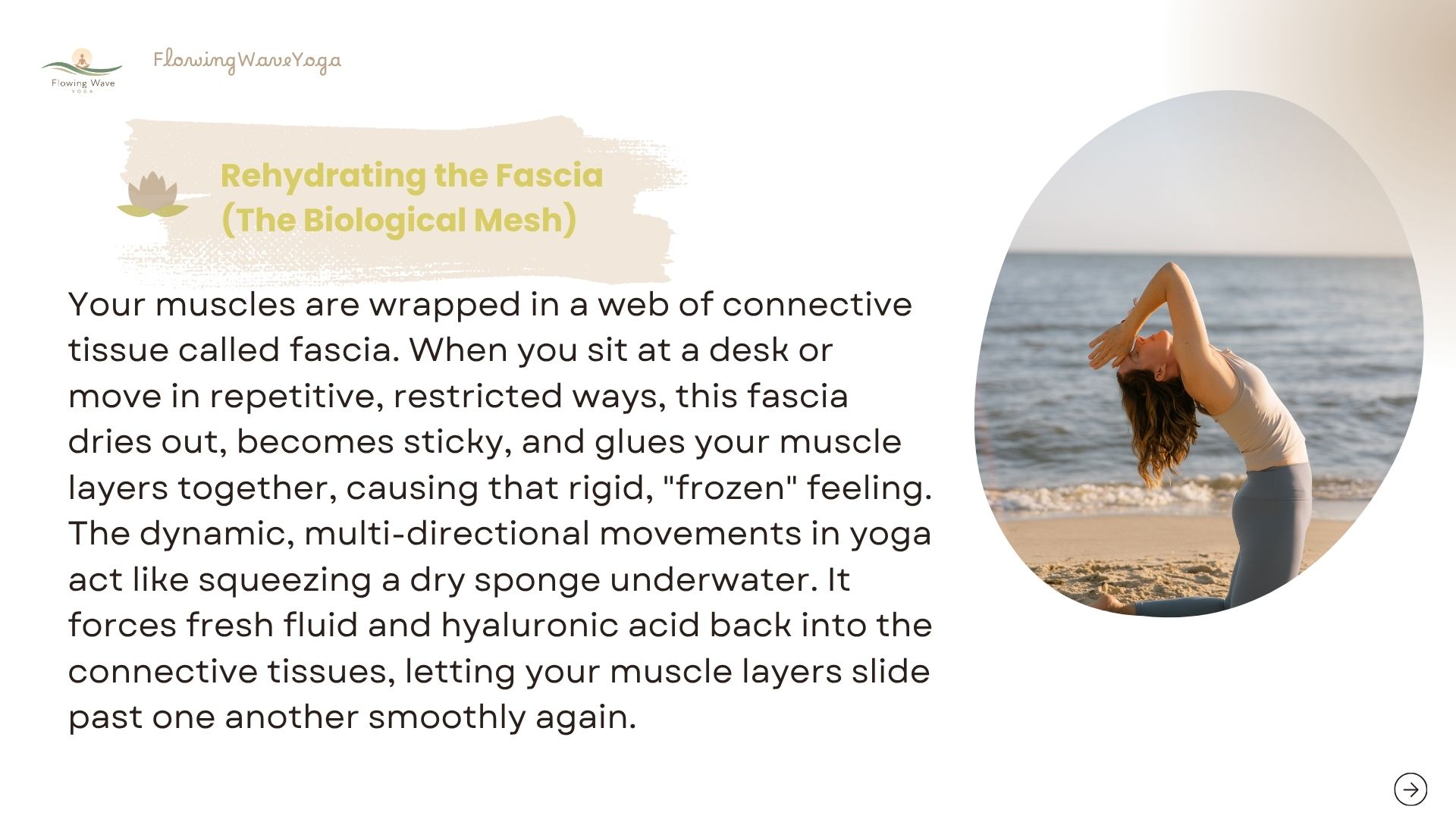
3. Rehydrating the Fascia (The Biological Mesh)
Your muscles are wrapped in a web of connective tissue called fascia. When you sit at a desk or move in repetitive, restricted ways, this fascia dries out, becomes sticky, and glues your muscle layers together, causing that rigid, "frozen" feeling.
The dynamic, multi-directional movements in yoga act like squeezing a dry sponge underwater. It forces fresh fluid and hyaluronic acid back into the connective tissues, letting your muscle layers slide past one another smoothly again.
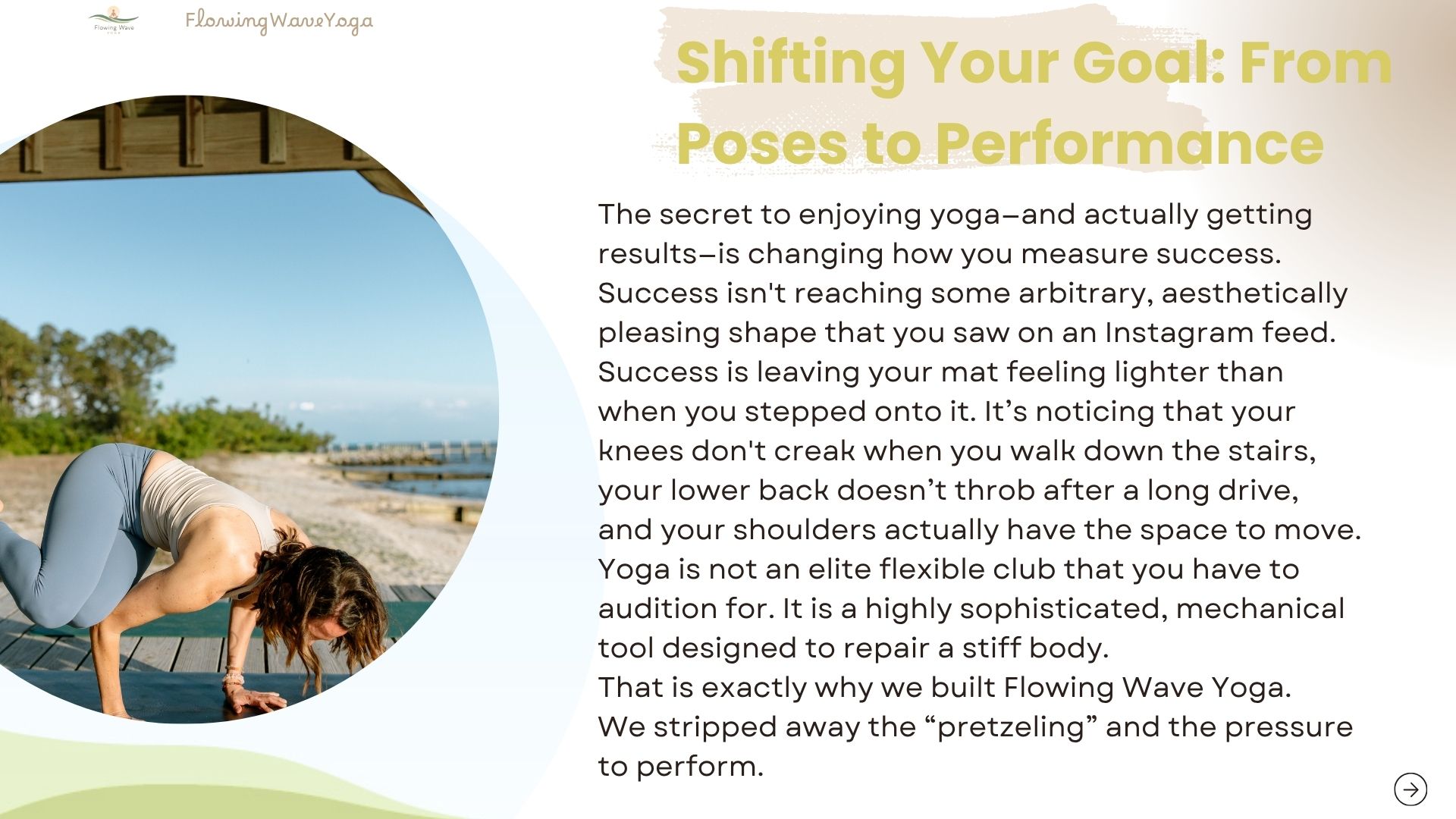
Shifting Your Goal: From Poses to Performance
The secret to enjoying yoga-and actually getting results-is changing how you measure success.
Success isn't reaching some arbitrary, aesthetically pleasing shape that you saw on an Instagram feed.
Success is leaving your mat feeling lighter than when you stepped onto it. It's noticing that your knees don't creak when you walk down the stairs, your lower back doesn't throb after a long drive, and your shoulders actually have the space to move.
Yoga is not an elite flexible club that you have to audition for. It is a highly sophisticated, mechanical tool designed to repair a stiff body.
That is exactly why we built Flowing Wave Yoga.
We stripped away the "pretzeling" and the pressure to perform.
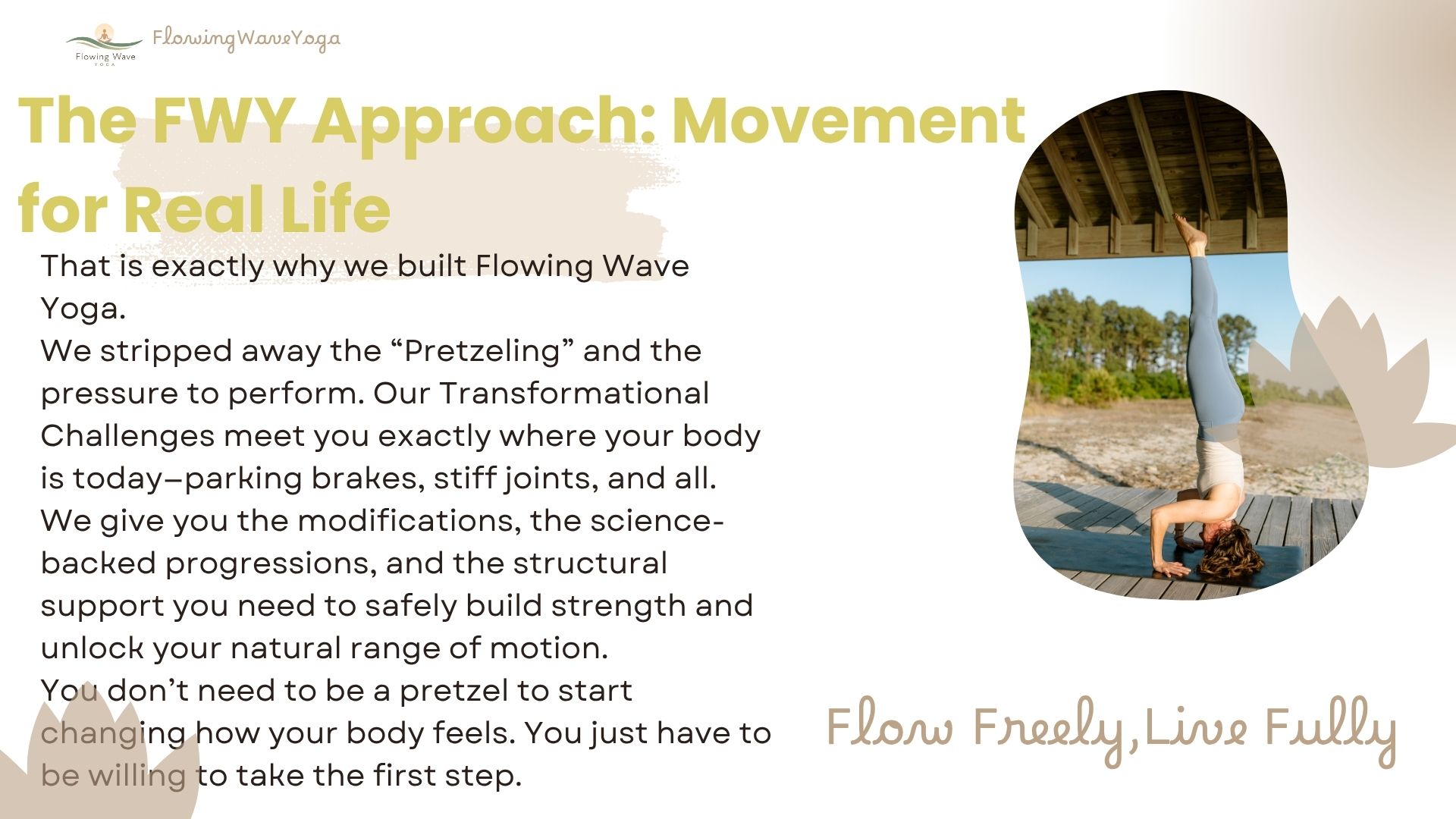
The FWY Approach: Movement for Real Life
That is exactly why we built Flowing Wave
Yoga.
We stripped away the "Pretzeling" and the pressure to perform. Our Transformational Challenges meet you exactly where your body is today-parking brakes, stiff joints, and all.
We give you the modifications, the science-backed progressions, and the structural support you need to safely build strength and unlock your natural range of motion.
You don't need to be a pretzel to start changing how your body feels. You just have to be willing to take the first step.
Flow Freely, Live Fully
Lalai & Julia
Start your journey with us today!
FlowingWaveYoga gives you the structure , support and system to move forward.