FLOWINGWAVEYOGA: THE SCIENCE OF FLUID MOVEMENT
Sep 30, 2026
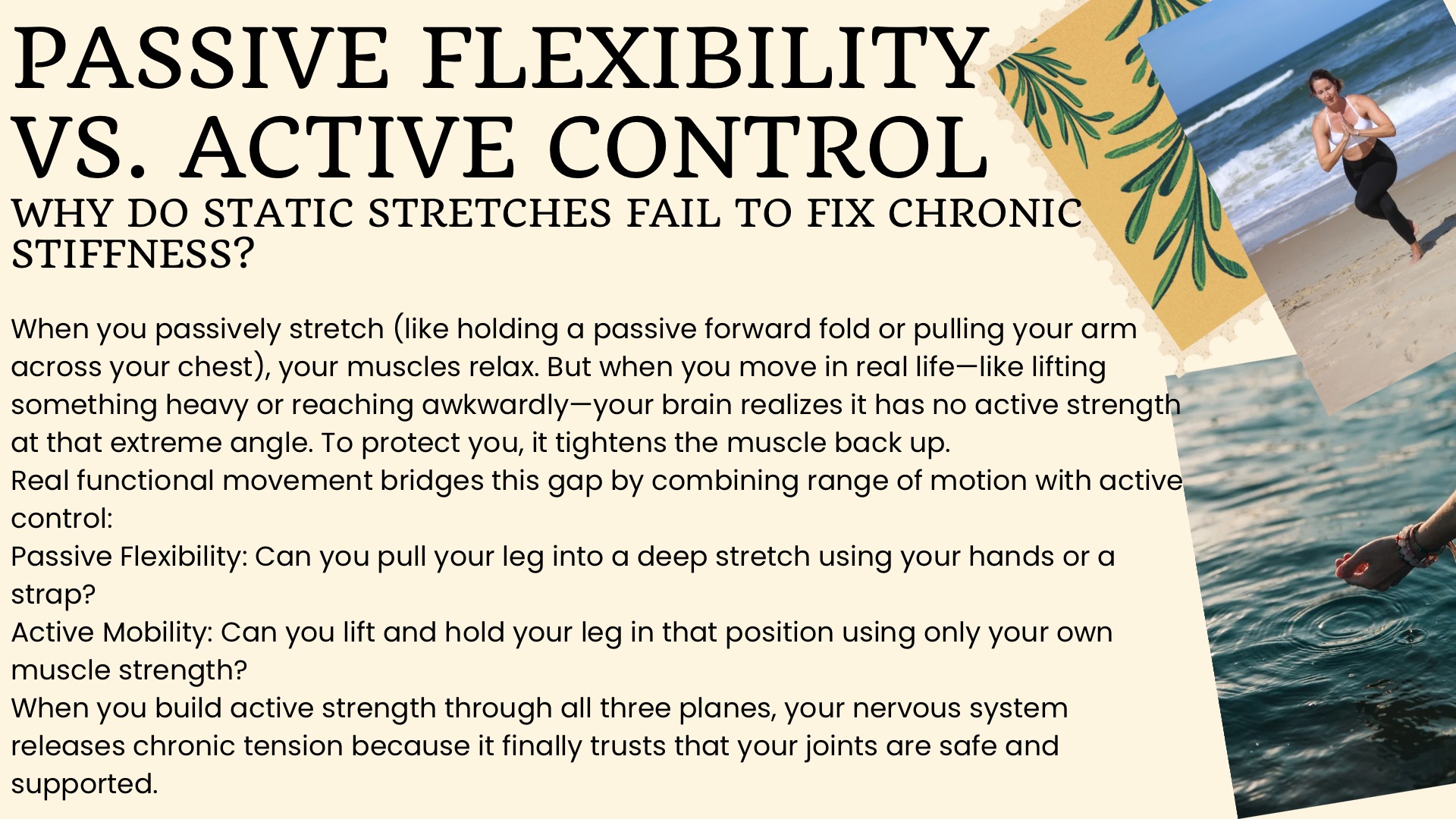

The other day, while I was out on the water waiting for a set, I watched the way waves adapt to everything around them. They don't fight the ocean floor, freeze up when conditions change, or break apart under pressure—they simply shift, flow, and find a way through.
Surfing is a constant reminder that rigid things break, but fluid things endure. Sitting on my board, it hit me: this is exactly how our bodies were meant to move.
Most of us spend our lives trapped in stiff, linear habits—sitting at desks, moving only forward and back, or holding static shapes on a mat. But real life demands that we twist, react, and move in 3D.
Water never breaks under pressure; it simply shifts, flows, and finds a way through. That same adaptable nature lives inside your body. FlowingWaveYoga was built to bridge the gap between ancient practice and modern movement science. We give you the tools to break out of linear motion, unlock stiff joints, and move through your daily life with complete physical freedom.
If you surf, lift, practice handstands, run, or you are chasing toddlers we all want the same thing: a body that feels strong, dynamic, and pain-free.
We believe your practice should be as fluid and resilient as water. At FlowingWaveYoga, we don’t just hold shapes; we train your body to move like water—strong enough to hold its form, flexible enough to adapt to change, and mobile enough to move through life without obstacles. We created our programs to bridge the gap between traditional yoga and functional longevity, helping you clear the roadblocks that keep you from moving with total freedom.
When hips feel tight or lower back start aching, the go-to solution for most people is static stretching or standard yoga. But after weeks of holding passive poses, that familiar stiffness often returns—and overall strength doesn't improve.
The issue isn’t a lack of effort. The issue is that human movement happens in three dimensions, but most of our daily lives (and workouts) happen in only one.
To build resilient joints, eliminate chronic aches, and unlock effortlessness in daily life, passive flexibility isn't enough. You need active control across every plane of motion.
Think about the daily demands we put on ourselves without realizing it:
Who Needs Functional Movement?
• The Daily Life Movers: We reach awkwardly into the back seat of the car, bend over to tie a shoe, carry bags of groceries up the stairs, or stand for hours on hard floors. When your body lacks fluid adaptability, these simple, everyday moments are where low back spasms and unexpected tweaks happen.
• The Movement Athletes: Whether you’re paddling into a wave that requires a sudden spinal twist, absorbing the repetitive impact of running, or pressing into a handstand, high performance demands that your joints handle force at extreme angles without giving out.
• The Desk Warriors: Sitting for eight hours a day trains your nervous system to stay locked in a folded, rigid position. Over time, rounded shoulders and tight hips stop being just a temporary feeling—they become your body’s default setting.
Here is the reality: whether you’re paddling out into the ocean or simply trying to get through the workday without an aching lower back, passive flexibility will only get you so far.
Holding a deep stretch feels good in the moment, but real life demands End-Range Strength—the active power, stability, and control to support your joints at the very edge of their reach.
And building that level of lasting resilience requires moving outside of straight lines and training across all three dimensions of life.
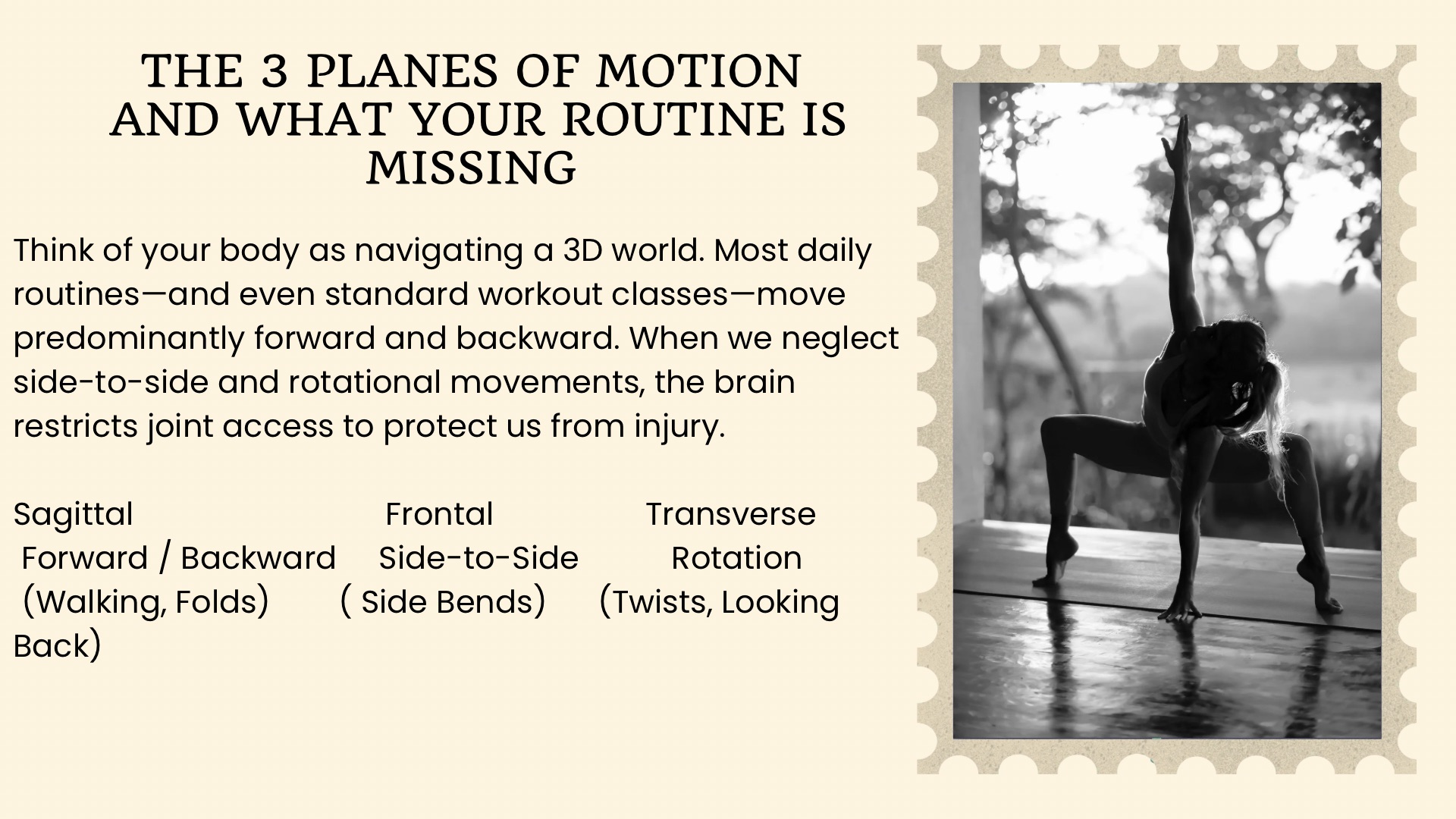
The 3 Planes of Motion (And What Your Routine Is Missing)
Think of your body as navigating a 3D world. Most daily routines—and even standard workout classes—move predominantly forward and backward. When we neglect side-to-side and rotational movements, the brain restricts joint access to protect us from injury.
Sagittal Frontal Transverse
Forward / Backward Side-to-Side Rotation
(Walking, Folds) ( Side Bends) Twists, Looking Back)
1. The Sagittal Plane (Forward & Backward)
• What it is: Divide your body into left and right halves. Any movement going forward or backward lives here.
• Everyday Examples: Walking, sitting down in a chair, running, standard push-ups, forward folds.
• The Reality: About 80% of life and fitness happens here. While crucial, overtraining only this plane makes movement rigid over time.
2. The Frontal Plane (Side-to-Side)
• What it is: Divide your body into front and back halves. Any side-to-side movement or lateral reaching happens here.
• Everyday Examples: Stepping sideways out of the way, side-planking, Cossack squats, reaching sideways to pick up a bag.
• Why You Need It: Lateral capacity stabilizes the hips, ankles, and spine. If your frontal plane is weak, your knees and lower back take the hit when you make sudden side-to-side adjustments.
3. The Transverse Plane (Rotation)
• What it is: Divide your body into top and bottom halves. Any twisting, spiraling, or rotational movement happens here.
• Everyday Examples: Turning around to look behind you in the car, twisting to pass a item to someone, popping up on a surfboard, swinging a golf club.
• Why You Need It: This is where injury prevention lives. The spine and hips are designed to rotate. When you lack controlled rotation, simple daily twists can trigger low back spasms or shoulder impingements.
Passive Flexibility vs. Active Control
Why do static stretches fail to fix chronic stiffness?
When you passively stretch (like holding a passive forward fold or pulling your arm across your chest), your muscles relax. But when you move in real life—like lifting something heavy or reaching awkwardly—your brain realizes it has no active strength at that extreme angle. To protect you, it tightens the muscle back up.
Real functional movement bridges this gap by combining range of motion with active control:
• Passive Flexibility: Can you pull your leg into a deep stretch using your hands or a strap?
• Active Mobility: Can you lift and hold your leg in that position using only your own muscle strength?
When you build active strength through all three planes, your nervous system releases chronic tension because it finally trusts that your joints are safe and supported.
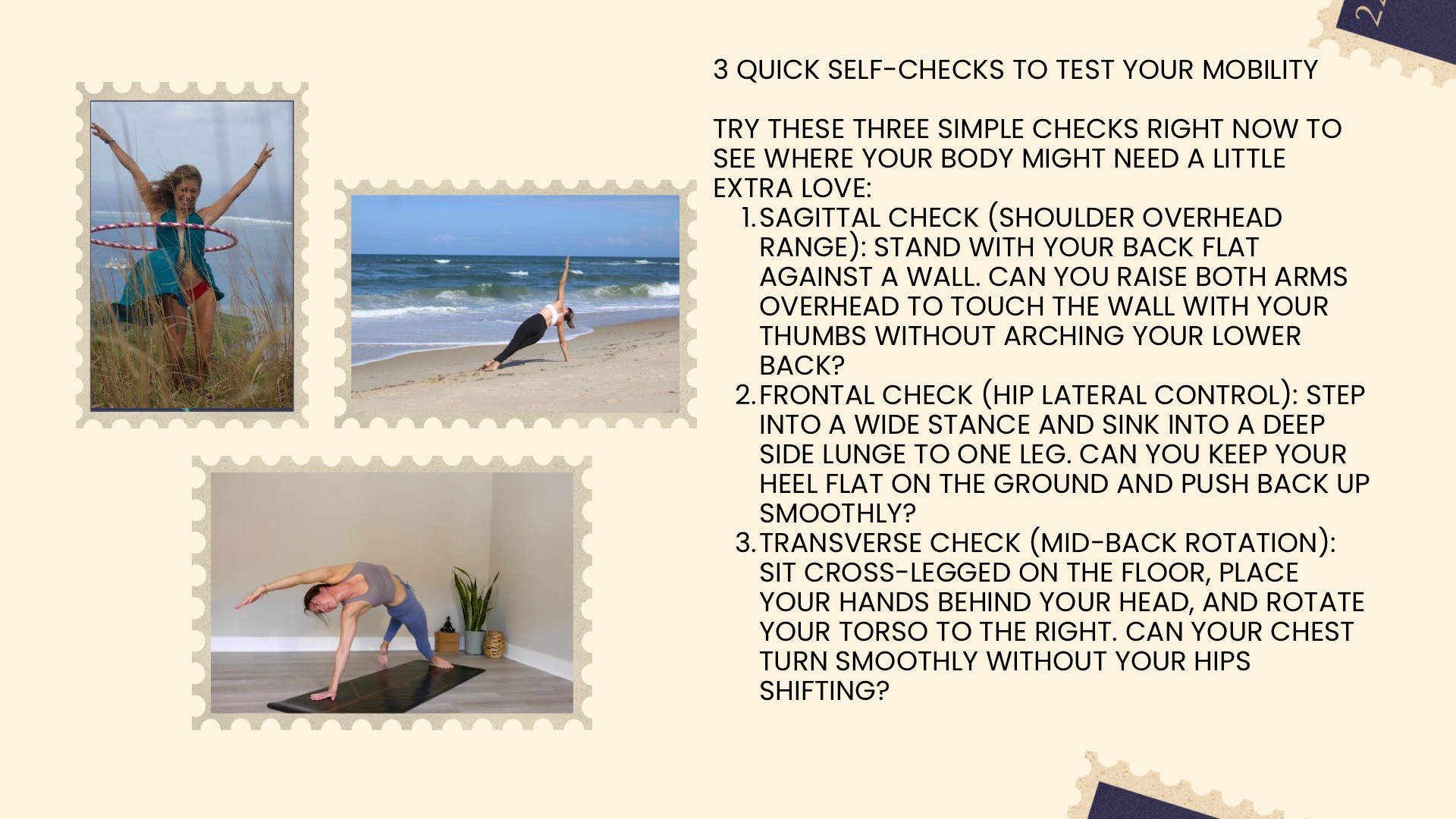
3 Quick Self-Checks to Test Your Mobility
Try these three simple checks right now to see where your body might need a little extra love:
1. Sagittal Check (Shoulder Overhead Range): Stand with your back flat against a wall. Can you raise both arms overhead to touch the wall with your thumbs without arching your lower back?
2. Frontal Check (Hip Lateral Control): Step into a wide stance and sink into a deep side lunge to one leg. Can you keep your heel flat on the ground and push back up smoothly?
3. Transverse Check (Mid-Back Rotation): Sit cross-legged on the floor, place your hands behind your head, and rotate your torso to the right. Can your chest turn smoothly without your hips shifting?
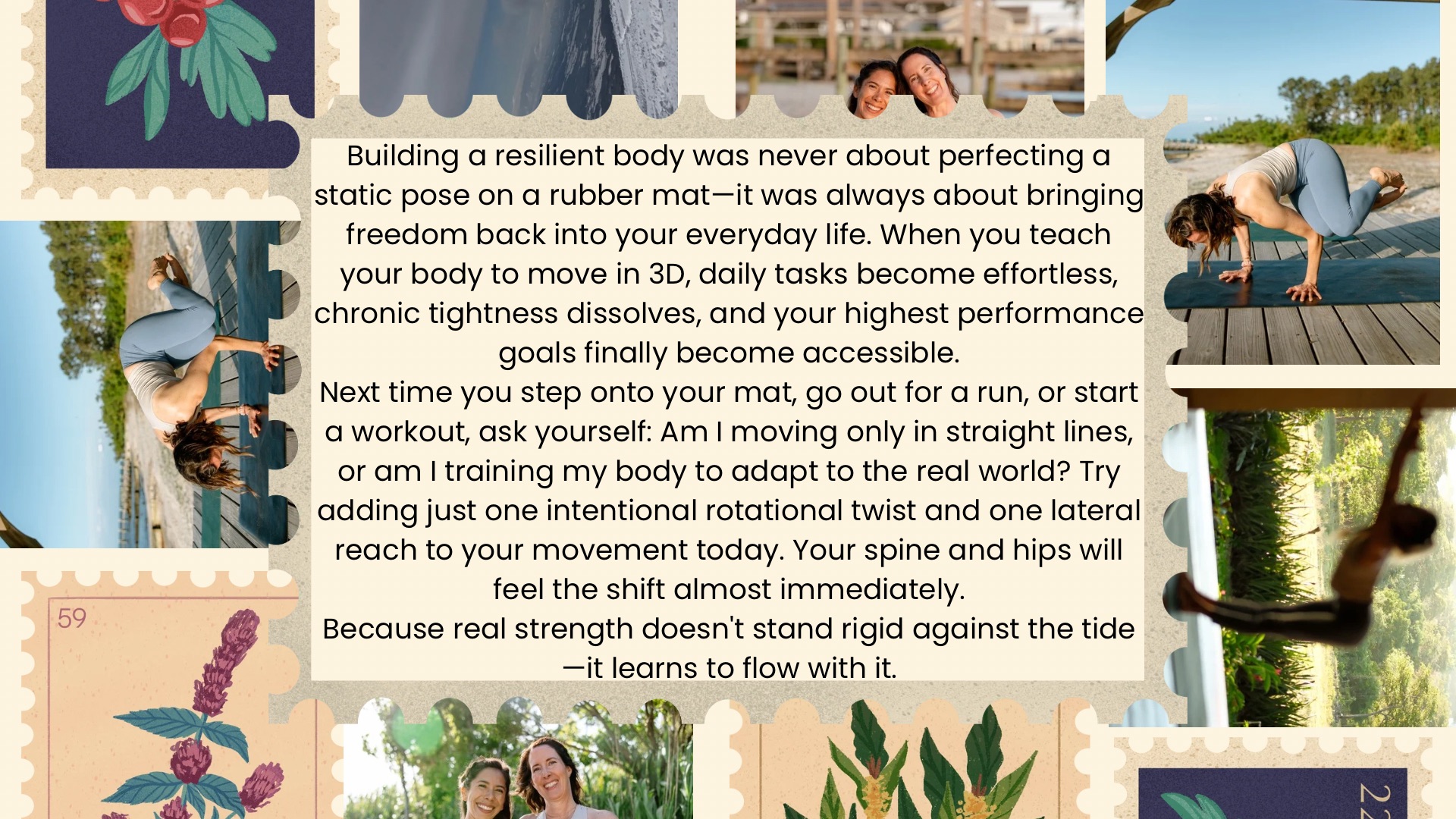
Building a resilient body was never about perfecting a static pose on a rubber mat—it was always about bringing freedom back into your everyday life. When you teach your body to move in 3D, daily tasks become effortless, chronic tightness dissolves, and your highest performance goals finally become accessible.
Next time you step onto your mat, go out for a run, or start a workout, ask yourself: Am I moving only in straight lines, or am I training my body to adapt to the real world? Try adding just one intentional rotational twist and one lateral reach to your movement today. Your spine and hips will feel the shift almost immediately.
Because real strength doesn't stand rigid against the tide—it learns to flow with it.
Coming Up Next: The Security Guard in Your Brain
Ever wonder why you can stretch your hamstrings for months, only to wake up feeling just as tight the next morning?
It turns out your muscles aren't actually stubborn—your nervous system is just trying to protect you. In our next post, we’re diving into the science of the "Stretch Reflex" and exploring why passive stretching makes your brain lock your joints down, while active mobility gives you the key to lasting freedom.
Start your journey with us today!
FlowingWaveYoga gives you the structure , support and system to move forward.